
Dentures
Elm Ridge offers complete dentures, partial dentures, immediate dentures, and implant-retained denture options for patients who need practical tooth replacement.
Request a Denture ConsultationDentures are not one-size-fits-all. Some patients need a complete denture to replace all teeth in an arch. Others need a partial denture to replace several missing teeth while keeping healthy teeth. Some patients need immediate dentures placed after extractions so they are not without teeth during healing.
Complete Dentures
Complete dentures replace all upper or lower teeth. They must be designed for appearance, speech, bite, and comfort. Adjustments are common as the gums heal and change.
Partial Dentures
Partial dentures replace multiple missing teeth while using remaining teeth for support. They can be a practical option when implants or bridges are not the right fit.
Immediate Dentures
Immediate dentures are designed so you never have to go without teeth after extractions. We take impressions and make the dentures prior to surgery, so they can be inserted "immediately" after the extractions are completed.
Important Expectations for Immediate Dentures
Because immediate dentures are made before teeth are removed, there are some unique challenges:
- Esthetics and bite cannot be fully verified beforehand.
- Perfect results cannot be guaranteed.
- Fit will change significantly during healing, and relines will be necessary to catch up with changes.
- Looseness is normal during the healing phase.
- Sore spots are common. Call early for adjustments if sore spots develop — do not wait for sores to become severe.
For these reasons, immediate dentures are often considered "temporary" or "healing dentures." A second denture may be needed after healing (roughly six months) to overcome these challenges.
An Honest Look at Traditional Dentures
A traditional denture sits on your gums, held in place by suction (upper) or gravity and adhesive (lower). It's made of acrylic with prosthetic teeth set into it. You take it out daily for cleaning. It costs the least of any tooth-replacement option.
What dentures do well
- They restore the cosmetic appearance of teeth.
- They cost a fraction of implant treatment.
- They don't require surgery.
- They can be made relatively quickly.
What dentures don't do well
- Function is reduced. Patients with traditional dentures have roughly 10% of the chewing force of someone with natural teeth or implants. Harder foods ? steak, raw vegetables, nuts, crusty bread ? become difficult or impossible to chew. Most denture patients change their diet without quite realizing how much.
- Comfort varies and degrades. A new denture might fit reasonably. But your jawbone shrinks every year you wear a denture, so the fit changes. Within 5 to 7 years, most dentures need to be remade or relined. Patients live with sore spots, ulcers, and the daily friction of acrylic on gum tissue.
- Bone loss is real and continuous. Without tooth roots stimulating the bone, the jaw resorbs ? meaning the bone literally shrinks over time. After 10-15 years of denture wear, the lower jaw can lose up to 60% of its original bone height. This is why long-term denture wearers develop a "sunken" facial appearance and why their dentures fit progressively worse no matter how many adjustments are made.
- Lowers slip; uppers cover the palate. Lower dentures are notoriously hard to keep in place ? there's nothing to push against. Upper dentures stay put with palatal suction, but covering the roof of your mouth dampens taste and adds a constant sensory presence patients never quite forget.
Honest framing
Traditional dentures are best understood as a cosmetic prosthesis. They restore the appearance of teeth and the position of the lips and cheeks. They are not a true functional replacement for natural teeth.
If you choose a traditional denture, it should be with a clear understanding of what you're getting and what you're not. We'll fit one beautifully if that's your choice — and we won't make anyone feel bad about it — but we'll always make sure the alternatives are understood first.
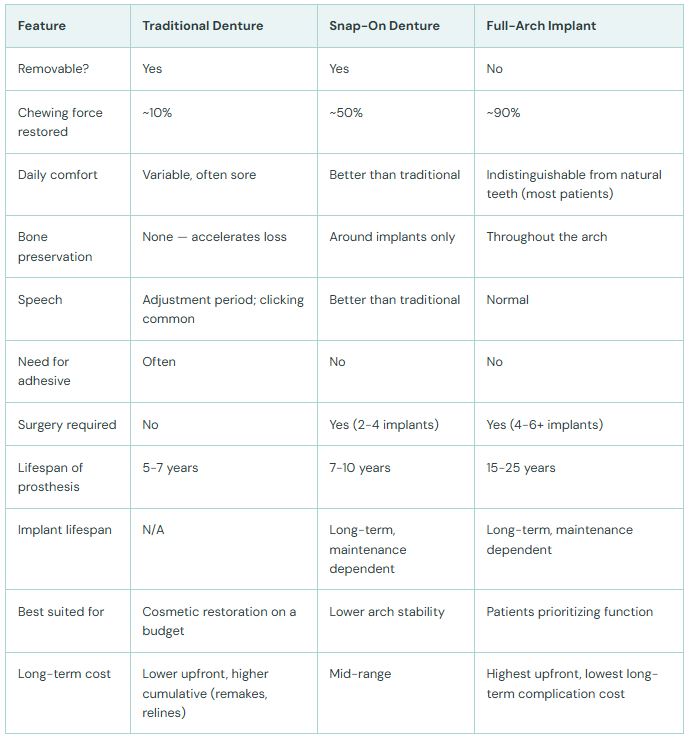
Side-by-Side Comparison
Need better tooth replacement options?
Schedule a ConsultationImmediate Denture Instructions
If dentures are placed the day teeth are removed, these instructions explain the first 48 hours and what to expect during healing.
View Immediate Denture Instructions